Communication begins from birth, long before children say their first words. Babies communicate through crying, facial expressions, eye contact, gestures, sounds, and body movements. As children grow, these early forms of communication gradually develop into words, sentences, conversations, and more complex social interactions. Understanding communication milestones in early childhood can help parents recognize typical language development and support their child’s communication skills.
Every child develops at a different pace. Milestones provide general guidance rather than strict deadlines, and differences in timing do not always indicate a problem.
Communication From Birth to 3 Months
Newborn babies primarily communicate through crying and body movements. Over the first few months, they gradually become more responsive to voices, faces, and sounds.
During this period, babies may:
- Calm when they hear a familiar voice
- Look toward sounds
- Make sounds other than crying
- Smile in response to interaction
- Watch a caregiver’s face
- Respond differently to familiar and unfamiliar voices
Talking, singing, and responding to a baby’s sounds can encourage early communication. Even though babies cannot understand full conversations yet, repeated interaction helps them become familiar with voices, sounds, and patterns of speech.
Communication From 4 to 6 Months
Between four and six months, babies often become more vocal and socially responsive. They may experiment with different sounds and show greater interest in conversations.
Common emerging skills include:
- Laughing and making sounds to gain attention
- Responding to changes in tone
- Turning toward familiar voices
- Taking turns making sounds with caregivers
- Making sounds such as squeals and babbling
- Using facial expressions to communicate emotions
Parents can encourage these skills by copying the baby’s sounds, pausing to allow a response, and talking about everyday activities.
Communication From 7 to 12 Months
During the second half of the first year, babies often develop stronger understanding of language and begin using gestures intentionally.
They may:
- Respond to their name
- Understand familiar words
- Babble using different sounds
- Use gestures such as waving or pointing
- Imitate sounds or actions
- Show interest in simple songs and games
- Look toward objects when they are named
Babies may understand more language than they can express. Parents can support this development by naming people, objects, and actions during everyday activities.
Communication From 1 to 2 Years
Toddlers typically make noticeable progress in expressive and receptive language during this period. Vocabulary begins expanding, although the number of words can vary considerably between children.
Many toddlers begin to:
- Use words to request familiar objects
- Point to objects or pictures when named
- Follow simple instructions
- Imitate words and sounds
- Combine words as language develops
- Identify familiar people and objects
- Use gestures alongside spoken words
Reading simple books together can support vocabulary development. Parents can point to pictures, name objects, and encourage children to communicate without pressuring them to repeat every word.
Communication From 2 to 3 Years
Children often begin using longer phrases and sentences during the third year. They may become increasingly interested in conversations and asking for information.
Emerging communication skills can include:
- Combining several words into sentences
- Naming familiar objects and actions
- Following two-step instructions
- Answering simple questions
- Talking about recent experiences
- Using pronouns and basic grammatical forms
- Participating in short conversations
Adults can encourage language development by listening carefully, expanding on what the child says, and introducing new vocabulary during everyday activities.
Communication From 3 to 4 Years
Preschool children generally develop more advanced language and conversational abilities.
Many children can:
- Speak in longer sentences
- Describe people, objects, and activities
- Tell simple stories
- Answer questions about familiar events
- Follow more detailed instructions
- Participate in back-and-forth conversations
- Use language during pretend play
- Ask questions to learn more about their surroundings
At this age, children benefit from regular reading, storytelling, imaginative play, and conversations about daily experiences.
Communication From 4 to 5 Years
By the fifth year, children’s communication becomes increasingly complex. They often use language to explain ideas, describe experiences, interact socially, and solve problems.
Children may:
- Tell stories with several connected events
- Speak in more detailed sentences
- Describe emotions and experiences
- Follow multi-step instructions
- Participate in longer conversations
- Use language during cooperative play
- Understand and use a growing range of vocabulary
- Adjust their communication depending on the situation
Adults can support these skills by asking children to describe what happened, encouraging storytelling, reading age-appropriate books, and giving them opportunities to speak with others.
Receptive and Expressive Language
Communication development includes both receptive and expressive language. Receptive language refers to what a child understands, while expressive language refers to how they communicate through words, sentences, gestures, and other methods.
A child may understand considerably more than they can say. Observing both areas provides a broader picture of communication development.
Communication also includes non-verbal skills such as eye contact, facial expressions, gestures, pointing, and body language.
Supporting Communication at Home
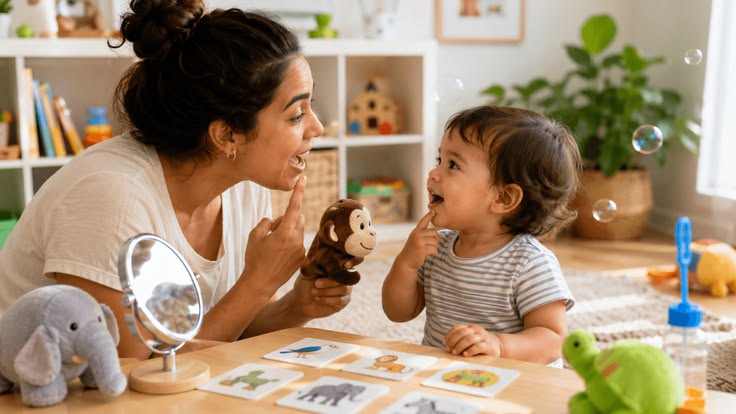
Parents can encourage communication through simple everyday interactions. Talking during meals, describing activities, reading books, singing songs, playing games, and responding to a child’s attempts to communicate can all provide valuable opportunities.
Instead of correcting every mistake, adults can model the correct form naturally. For example, if a child says a short phrase, a parent can respond with a slightly longer sentence that adds useful vocabulary.
Limiting passive screen time and prioritizing direct interaction can also provide more opportunities for children to practise communication.
Recognizing Communication Concerns
Children develop at different rates, but certain patterns may warrant professional attention. Concerns may include very limited communication, difficulty understanding simple language, lack of gestures, limited response to sounds or names, persistent difficulty being understood, or loss of previously acquired communication skills.
Hearing problems can also affect speech and language development. If parents have concerns, discussing them with a pediatrician or qualified speech and language professional can help determine whether developmental screening or further assessment is appropriate.
Dr. Nikil Sudarsan is a highly experienced Pediatrician in Dubai, dedicated to providing comprehensive healthcare for infants, children, and adolescents. With expertise in Pediatric Neurology, Child Development, Autism, ADHD, Epilepsy, Genetics, and Developmental Disorders, he offers personalized, evidence-based care tailored to each child’s unique needs. Using the latest medical advancements and a family-centered approach, Dr. Nikil Sudarsan focuses on promoting healthy growth, early diagnosis, effective treatment, and long-term well-being, ensuring the best possible outcomes for every child.