
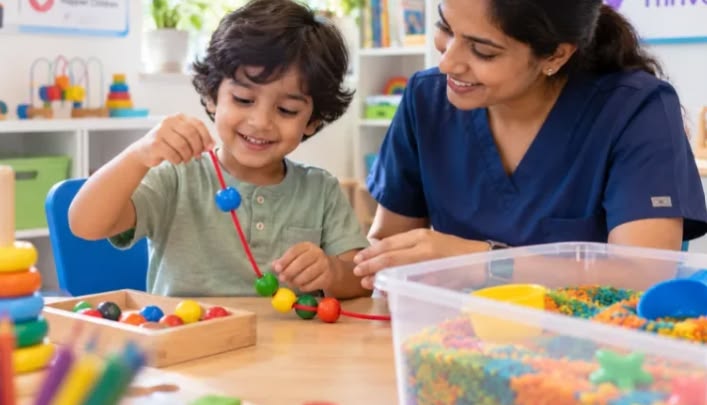
Every child develops at their own pace, and differences in development are common during early childhood. Some children may begin talking earlier, while others may take more time to develop language skills. One child may become physically independent quickly, while another may need additional support with everyday activities. Understanding developmental differences in children helps parents recognize normal variations while also identifying signs that may need professional attention.
Child development involves several areas, including physical, cognitive, communication, social, emotional, and adaptive skills. These areas do not always progress at the same speed. A child may be advanced in one area and still developing in another. Looking at the whole child rather than focusing on a single milestone provides a more accurate understanding of development.
Development Varies From Child to Child
Developmental milestones provide general guidelines for skills that many children achieve within a particular age range. They are not strict deadlines. Genetics, environment, nutrition, health, learning opportunities, personality, and family interactions can all influence development.
For example, some children may walk before their first birthday, while others may take several additional months. Similarly, vocabulary can vary considerably among young children. These differences do not automatically indicate a developmental problem.
Parents can use milestones as helpful reference points rather than as a way to compare one child with another. Consistent progress is generally more important than achieving every skill at exactly the same age.
Physical Development Differences
Physical development includes growth, movement, coordination, strength, and the ability to perform everyday tasks. Young children gradually develop skills such as sitting, crawling, walking, running, jumping, climbing, holding objects, drawing, and feeding themselves.
Differences in physical development can be influenced by temperament and opportunities for movement. Some children are naturally active and enjoy climbing and running, while others prefer quieter activities.
Parents can encourage physical development by providing safe opportunities for movement and play. Activities such as walking, playing with balls, building blocks, drawing, and age-appropriate outdoor games can support both gross and fine motor skills.
Language and Communication Development
Communication development includes understanding language, using words, gestures, facial expressions, and eventually forming sentences and conversations. Children may differ significantly in when they begin using words and how quickly their vocabulary grows.
A child who understands instructions but uses fewer words may have a different communication profile from a child who speaks frequently but has difficulty understanding others. Listening, responding, using gestures, and interacting socially are all important parts of communication.
Parents can support language development by talking regularly with children, reading together, naming everyday objects, singing songs, and responding to their attempts to communicate. Creating opportunities for conversation can help children build confidence and language skills.
Cognitive and Learning Differences
Cognitive development involves thinking, remembering, learning, problem-solving, attention, and understanding relationships between objects and ideas. Children develop these abilities through exploration, play, observation, and interaction.
Some children may quickly understand puzzles, numbers, patterns, or spatial concepts. Others may show stronger abilities in storytelling, imaginative play, music, or social interaction. Learning differences can become more noticeable as children enter structured educational environments.
Providing age-appropriate activities and allowing children to explore different interests can support cognitive development. Parents should focus on progress and learning rather than comparing children with siblings or classmates.
Social and Emotional Development
Social and emotional development involves forming relationships, expressing feelings, understanding emotions, sharing, cooperating, and responding to social situations.
Young children may initially find sharing or waiting for their turn difficult. Over time, they gradually learn to recognize emotions and understand how their behavior affects others. Some children are naturally outgoing, while others may be shy or cautious in unfamiliar situations.
Parents can support social and emotional development by helping children name their feelings, modeling appropriate behavior, establishing predictable routines, and providing opportunities to interact with other children.
Differences in Behavior and Attention
Children can vary widely in activity levels, attention spans, reactions to changes, and responses to instructions. Occasional difficulty sitting still, following directions, or managing emotions is common in early childhood.
However, persistent difficulties that interfere with learning, relationships, communication, or everyday activities may deserve closer attention. Parents should consider how frequently a behavior occurs, how intense it is, and whether it appears across different environments.
Observing patterns over time can provide useful information when discussing concerns with a pediatric or developmental professional.
Factors That Can Influence Development
Several factors can affect how children develop. Genetics play an important role, while environmental experiences also contribute significantly. Nutrition, sleep, physical health, emotional well-being, family relationships, learning opportunities, and exposure to language can all influence development.
Premature birth, certain medical conditions, hearing or vision difficulties, and other health factors may also affect specific developmental areas. This is why developmental differences should be considered within the child’s overall health and individual circumstances.
Recognizing When Additional Support May Help
Developmental differences do not always indicate a disorder, but certain patterns may warrant professional evaluation. Parents may benefit from seeking guidance if a child consistently struggles to acquire age-appropriate skills, loses a skill they previously had, has significant communication difficulties, shows limited social interaction, or experiences challenges that interfere with daily life.
A developmental assessment can look at multiple areas rather than focusing on one behavior. Professionals may evaluate communication, motor abilities, learning, social interaction, behavior, and adaptive skills.
Early identification can be helpful because appropriate support can be introduced when a child needs it. Support may include developmental guidance, speech and language therapy, occupational therapy, educational assistance, behavioral support, or other services depending on the child’s needs.
Supporting Every Child’s Development
Children benefit from supportive and responsive environments. Parents can encourage development through everyday activities such as reading, talking, playing, exploring outdoors, practicing self-care skills, and spending quality time together.
Healthy sleep habits, balanced nutrition, regular physical activity, and appropriate screen-time routines can also contribute to overall well-being. Most importantly, children need encouragement rather than constant comparison.
Understanding developmental differences in children allows parents to appreciate individual strengths while remaining attentive to areas where additional support may be helpful. Development is a gradual process, and each child follows a unique path. By observing progress, encouraging learning, and seeking professional guidance when concerns arise, parents can provide children with the support they need to grow and develop confidently.
Dr. Nikil Sudarsan is a highly experienced Pediatrician in Dubai, dedicated to providing comprehensive healthcare for infants, children, and adolescents. With expertise in Pediatric Neurology, Child Development, Autism, ADHD, Epilepsy, Genetics, and Developmental Disorders, he offers personalized, evidence-based care tailored to each child’s unique needs. Using the latest medical advancements and a family-centered approach, Dr. Nikil Sudarsan focuses on promoting healthy growth, early diagnosis, effective treatment, and long-term well-being, ensuring the best possible outcomes for every child.