
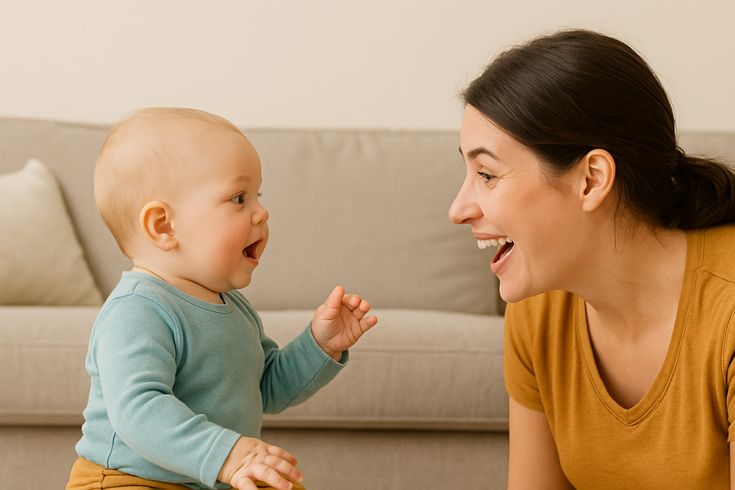
Speech and language development in children is an important part of early childhood growth. Communication allows children to express their needs, understand others, build relationships, learn new concepts, and participate in everyday activities. Although every child develops at their own pace, monitoring communication skills can help parents recognize progress and identify concerns that may need professional attention.
Speech refers to how children produce sounds and words, while language includes understanding and using words, sentences, gestures, and other forms of communication. Both areas develop gradually from infancy through childhood and are influenced by a child’s environment, interactions, hearing, learning abilities, and overall development.
Early Communication Skills
Communication begins before children say their first words. Babies communicate through crying, facial expressions, eye contact, gestures, sounds, and body movements. Over time, they begin responding to voices, recognizing familiar people, making different sounds, and using gestures to communicate.
Parents can encourage early communication by talking to babies throughout the day, responding to their sounds, making eye contact, singing songs, and describing everyday activities. These simple interactions provide opportunities for children to hear language and understand how communication works.
Development of First Words
As children grow, they gradually begin using sounds and words to communicate. They may first use simple words to identify familiar people, objects, or activities. Their vocabulary usually expands as they interact with parents, caregivers, siblings, and other children.
Reading books, naming objects, singing songs, and talking about daily routines can help children learn new words. Parents can also repeat and expand on what their child says. For example, if a child says “ball,” a parent might respond with “Yes, a big red ball.”
Building Vocabulary and Sentences
Children gradually move from single words to short phrases and then more complex sentences. They begin learning how to describe objects, ask for things, talk about experiences, and communicate their thoughts.
Regular conversation provides valuable opportunities for language learning. Parents can ask age-appropriate questions, introduce new words, and encourage children to describe what they see or do. However, conversations should feel natural rather than like formal lessons.
Understanding Language
Language development involves more than speaking. Children also need to understand what other people say. Receptive language includes recognizing words, following instructions, understanding questions, and making sense of conversations.
Parents can support understanding by giving simple instructions, reading stories, and talking about familiar routines. As children develop, instructions and conversations can gradually become more detailed.
The Role of Hearing
Hearing plays an important role in speech and language development. Children need to hear sounds clearly to learn how words are pronounced and understand spoken language.
Hearing difficulties can sometimes affect communication development. If a child does not respond consistently to sounds, frequently asks for repetition, or appears to have difficulty understanding speech, parents should discuss these observations with a healthcare professional.
Identifying hearing concerns early can help children receive appropriate evaluation and support.
Encouraging Communication at Home
Parents can support speech and language development in children through everyday activities. Talking during meals, describing activities, reading books, singing songs, and playing pretend games can all create opportunities for communication.
Instead of correcting every pronunciation mistake, parents can model the correct word naturally. If a child says a word incorrectly, repeating it correctly in a supportive way allows the child to hear the appropriate pronunciation without feeling discouraged.
Giving children time to respond is also important. Some children need additional time to organize their thoughts and express themselves.
The Importance of Reading
Reading together is one of the simplest ways to encourage language development. Picture books introduce children to new vocabulary, sentence structures, ideas, and storytelling.
Parents can point to pictures, name objects, describe characters, and discuss what is happening in the story. As children become older, they can be encouraged to predict what might happen next, describe pictures, and retell familiar stories.
These activities support vocabulary, comprehension, memory, and communication skills.
Social Interaction and Language Skills
Children develop communication skills through interaction with others. Playing with siblings, parents, caregivers, and peers gives children opportunities to practice listening, taking turns, expressing emotions, and responding to others.
Social experiences can also help children understand non-verbal communication, such as facial expressions, gestures, and body language.
Creating positive opportunities for interaction can therefore support both language development and broader social development.
Recognizing Possible Delays
Children develop at different rates, but certain signs may require closer attention. Parents may notice that a child uses very few words, has difficulty understanding simple instructions, does not respond to sounds or their name, struggles to communicate needs, or loses previously acquired communication skills.
A delay does not automatically mean that a child has a serious developmental condition. However, concerns should be discussed with a pediatric healthcare professional rather than ignored. Evaluation may include developmental assessment, hearing assessment, or referral to a speech and language professional when appropriate.
Supporting Children With Communication Difficulties
When a communication difficulty is identified, early support can be valuable. Depending on the child’s needs, support may focus on vocabulary, pronunciation, understanding language, sentence formation, social communication, or other areas.
Parents can work alongside healthcare and speech-language professionals to continue supportive activities at home. Consistency and encouragement can help children practice new communication skills in familiar environments.
Dr. Nikil Sudarsan is a highly experienced Pediatrician in Dubai, dedicated to providing comprehensive healthcare for infants, children, and adolescents. With expertise in Pediatric Neurology, Child Development, Autism, ADHD, Epilepsy, Genetics, and Developmental Disorders, he offers personalized, evidence-based care tailored to each child’s unique needs. Using the latest medical advancements and a family-centered approach, Dr. Nikil Sudarsan focuses on promoting healthy growth, early diagnosis, effective treatment, and long-term well-being, ensuring the best possible outcomes for every child.